

Freddie Mercury's Magic
A poem from the forthcoming collection 'red, white, and blues'

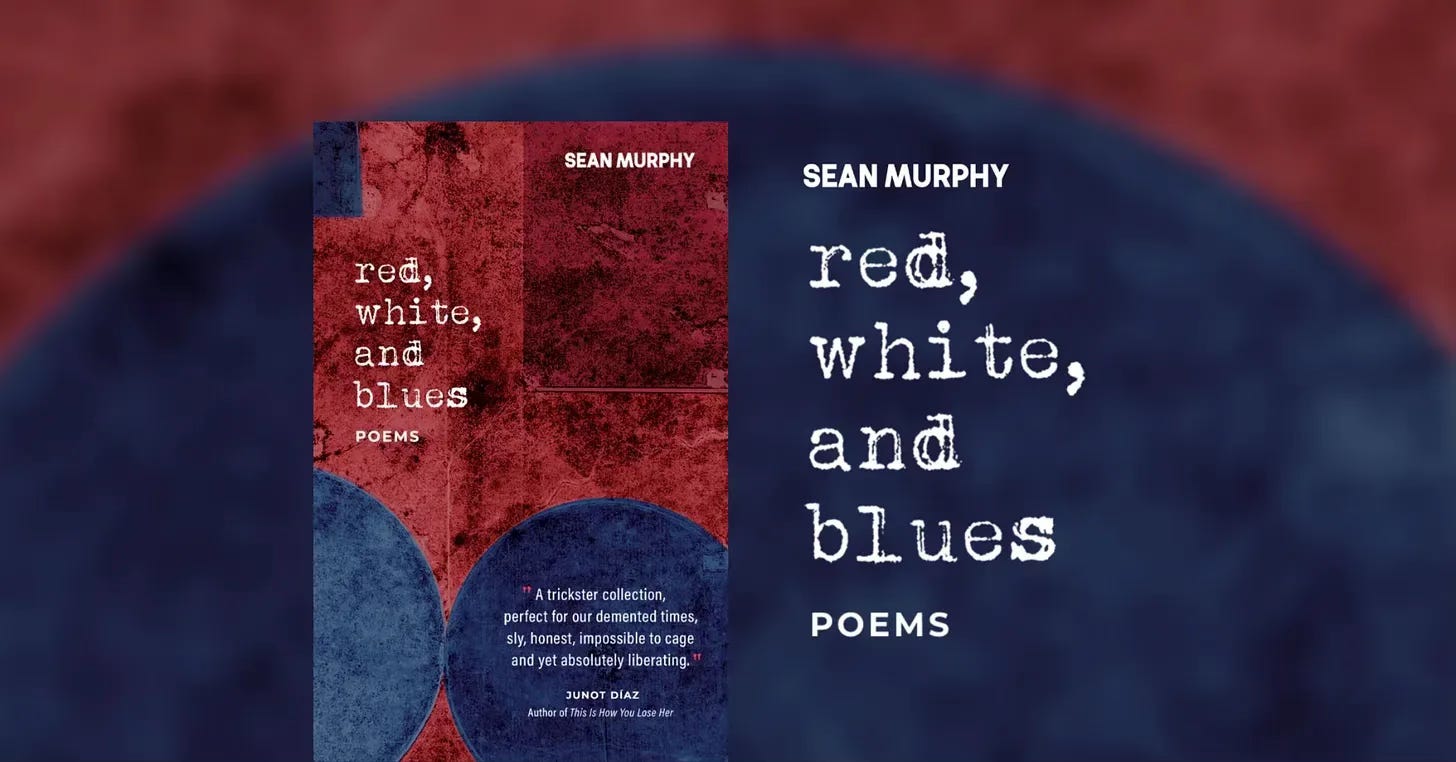
red, white, and blues is the fourth installment of a large, ongoing project acclaimed artist Matthew Shipp describes as “a kaleidoscopic, deep, and opulent journey.” Once more, I’m exploring America and its mythology through a series of poems that function as biography, history, and cultural commentary. Where the previous collections interrogated these concerns primarily through the lens of jazz and blues musicians, these poems home in on politics—and key players who have shaped our shared culture. A moral cross-examination covering history, war, religion, and pop spectacle, this collection asks what we worship, what we excuse, and what the stories we tell do to us.
I wrote red, white, and blues because I believe poetry can still tell the truth when other forms have failed us. These poems are not interested in neutrality; they are interested in clarity. They move through history and pop culture because that is where our myths live—where power learns to hide and where harm learns to look inevitable. (I also have come to believe poetry is the best way to mash up history, media, political commentary, and provides a succinct formula for connecting dots in ways Op-Eds, fiction, and social media grandstanding can’t and won’t). I wanted to write a book that names what we worship, what we excuse, and what we leave behind, while still honoring the strange, stubborn beauty that survives in language. If these poems bruise, I hope they also invite conversation. If they provoke, I hope they also connect. Art matters because it reminds us that we are not alone in our witnessing.
These poems are political, name names, and while I don’t have any illusions my modest efforts can affect the type of meaningful change we desperately need, it’s a flag flown in solidarity, and a middle finger to the establishment. As such, I think it’s coming into the world at the right time—and perhaps can inspire some dialogue or instigate something positive.
It’s at once more difficult and more satisfying to try and nail down a scumbag like Jeff Bezos and capture his essence, in less than one page, than it is to write dozens of impassioned, ultimately ineffectual and instantly dated Op-Eds. Hence what I’m trying to accomplish with this poetic project. Whether my modest efforts make the slightest difference matters less to me than the fact that this poem will be relevant and applicable one year, ten years, one hundred years from now. When the buffoon that’s helping wreck the planet is a gross footnote to an era when America was at its worst, and some of the sickest people who ever shared oxygen with other human beings ruled the world. Like Ozymandias, their time was brief, the damage significant, and their example used as cautionary tale.
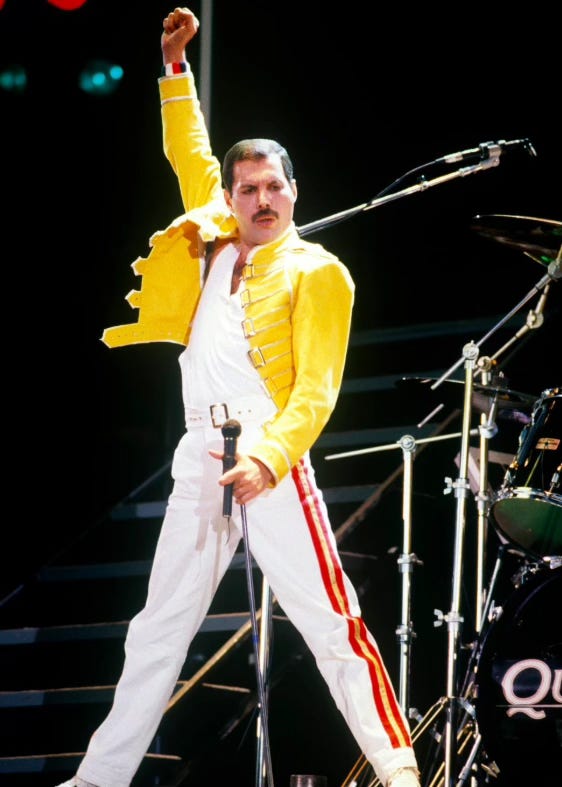
(*Author’s note: for any poem—or any piece of writing—to work, it needs to make its own case, and the writer should stay out of the way, for all the right reasons. So I’ll simply add that this one was a challenge—how to summarize this force of nature, compressing his multitudes into one page?—but it was also tremendous fun, seeing how many song titles & lyrics, references, and innuendos (SWIDT?) as possible, all in the service of celebrating an artist who continues to bring us indescribable joy, while also eulogizing the end of one era and the beginning of another—and vice versa, so on and et cetera.)
Freddie Mercury’s Magic
Goodbye, everybody: I’ve got to go / Gotta leave you all behind and face the truth.
—Queen
There was nothing Bohemian about the early 90s: a rhapsody of dollar drafts, pegged jeans, and happy hours featuring free wings, hairspray, Drakkar Noir, and other chemically assembled abominations. And smoke, always the smoke; we knew it was going to kill us, but so was everything else, like wars and politicians and day jobs and cops and, all of a sudden, simply having sex. Keep yourself alive? We thought we were all going to die, even or especially the compulsive sorts who actually wore condoms. Here we were, caught in a landslide called fin de siècle and suddenly this insanity from Africa (where, we’d learned in college, everything came from anyway, no matter what motion pictures or the bible said). A kind of magic: monkey business always a big hit in America. Crazy little thing: the planet finally wiped out, for love no less (or at least fucking, which is what we lived for in the first place). Why us, we cried, thinking of the 60s—or even the 80s—when sex was expensive but seldom an accessory, a little body language now a matter of life and death. What had we wrought? Rock not so hard after all, and if movie stars could die, what hope did frat boys have? Magic was tragic: even sports gods getting waylaid by weird science. Play the Game, a motto for every anonymous romp, experiments some of us hoped might lead to something more serious, not marriage so much as monogamy, where we could be the heroes of our own stories, the lives we saved our own, et cetera. The show must go on, we knew—so we drank & rode dirty, hangovers now including the occasional blood test at a free clinic (stay positive, we didn’t say). Is this the real life? Russian Roulette in the sheets and nuclear winter in our shorts. Joking about the gay flu not so funny anymore (Spare him his life from this monstrosity!); nothing really matters until a hijacked plane crashes in your back yard, all of us potential terrorists hoping a little STD might be as bad as it ever got. Just Say No, we couldn’t say, and it seemed like all the dead ancestors were biting back, a reminder of medieval times when plagues ate your face and wiped-out world history. Who wants to live forever, we boasted, half in the bag, all judgment suspended so we could get in someone’s pants. Don’t stop me now, we pouted, willing to believe in God or even George Bush if that would buy us more time. Another one bites the dust: everything commercials & songs taught us to demand ending us before lethargy or adulthood even had a chance. I want it all, each of us declared in our own style, hoping Freddie had taken one for the team, a dirty saint made to suffer so we could sin on, lip synching his songs as we drove blind toward whatever destiny had designed.