


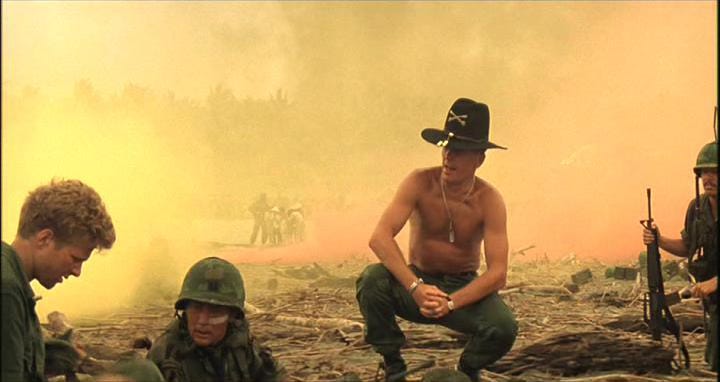
I love the smell of napalm in the morning.
It’s ridiculous, really.
But it’s supposed to be. And with just about any other A-list actor from the ‘70s, it would have been. Visualize award-winners ranging from De Niro to Pacino to Hoffman (ha) saying that same line and it not being farcical.
For this to work, it had to have the Sound & Vision of a guy who was The Guy. And all credit to the writing and direction, obviously. But in order to sell this psychopath—a role that became instantly iconic, turning what was supposed to be a sobering appraisal of sociopathy into a celebration (something we’d see less than a decade later with Michael Douglas’s indelible performance as Gordon Gekko), Colonel Kilgore became a hero (or, at worst, an anti-hero, with a wink and a nod)—you needed a dude that was not just capable of acting like an Alpha, you needed An Alpha. Enter Robert Duvall.
The same bruiser who became the Great Santini, but also the brooding big man behind the scenes in The Conversation. The subdued power player in Network. The impish weasel in The Natural. The quiet icon of Tender Mercies. The religious murderer on the run in The Apostle. And dozens of other roles. Tom Hagen anyone? He does more simple, effective acting just cooly finishing his dinner while Wolz rages, only one of them realizing a horse’s head was in their immediate future.
What else?
I can do light work here and call it a day because everyone else is going to say the same things. Read the tributes, re-read that bio, and mostly, re-watch the movies, especially the ones you’ve already seen too many times.
Once more, with feeling—from the forthcoming collection. RIP Colonel.
Colonel Kilgore’s Concerto
after Apocalypse Now
When the fat lady finally sings it reminds us that Wagner’s operas—which, aside from conquest, were in some quarters considered the singular height of human achievement—tended to celebrate not only war, but war amongst the gods, and more, the twilight of those gods, signaling it was time, at last, for heroes on earth.
When the fat lady sings it reminds us that even in the 20th Century Wagner’s operas, in some quarters, signified that empire was waning, or final solutions needed implementing—depending on which biographies have been updated, which news outlets one relies on, or which political party is inspiring a new kind of recruit for the cause.
When the fat lady sings it’s the militant score for a movie, and once—depending upon what books one reads—served as a soundtrack inspiring if not celebrating murder (of Jews, amongst gods); but mostly, for the purposes of this poem, the fat lady’s song provides the soundtrack to accompany a massacre, itself a reminder that Charlie don’t surf.